

India recorded 428.7 crore domestic tourist visits in 2025, a 45.5% increase over 2024. Yet, international air arrivals remain concentrated around major gateways, with Delhi and Mumbai airports handling 60% of foreign air arrivals in the same year.
For landowners, developers and investors, this presents an important question: Can India’s expanding domestic travel market support viable hospitality assets beyond metropolitan cities?
At Crescent Resorts Group, a well-known brand in Central India, offers us a perspective on how hospitality opportunities differ across urban, highway-corridor and leisure markets. The opportunity is significant, but location alone does not determine commercial success. Demand quality, competitive supply, operating costs and professional management are equally important.
Tourism Growth Does Not Guarantee Hotel Demand
Tourist visits and hotel room nights are different measures. A pilgrimage visit, a day trip or a family visit may contribute to tourism statistics without generating an overnight booking.
The distinction matters for investors. Hotel viability depends on who stays, for how long, at what price and during which periods of the year. State-level tourism data also requires careful interpretation. The Reserve Bank of India’s Handbook of Statistics on Indian States 2024–25 records substantial year-to-year variations in Madhya Pradesh’s reported domestic tourist visits.
Such changes reinforce the need to examine the underlying data before using tourism growth as the basis for a financial projection. For a hospitality project, national and state statistics are starting points. Investment decisions must ultimately rest on demand within the specific micro-market.
What Hotel Performance and New Supply Reveal
ICRA’s November 2025 review identified Tier 2 and Tier 3 cities, airport hotels and spiritual destinations among the areas attracting new premium hotel supply.
Growth, therefore, comes with competition. Hotelivate’s findings, reported by Hotel Investment Today, indicate first-year occupancy of 40%–45% for new hotels and highlight the challenges of stabilisation as supply expands.
For investors, the implication is clear: a market with limited branded accommodation is not necessarily underserved. Existing independent hotels, upcoming projects, achievable room rates and the seasonality of local demand must all be assessed before committing capital.
Crescent Resorts: Understanding Different Market Contexts
Crescent Resorts Group’s presence in Madhya Pradesh illustrates why hospitality development requires a location-specific approach.
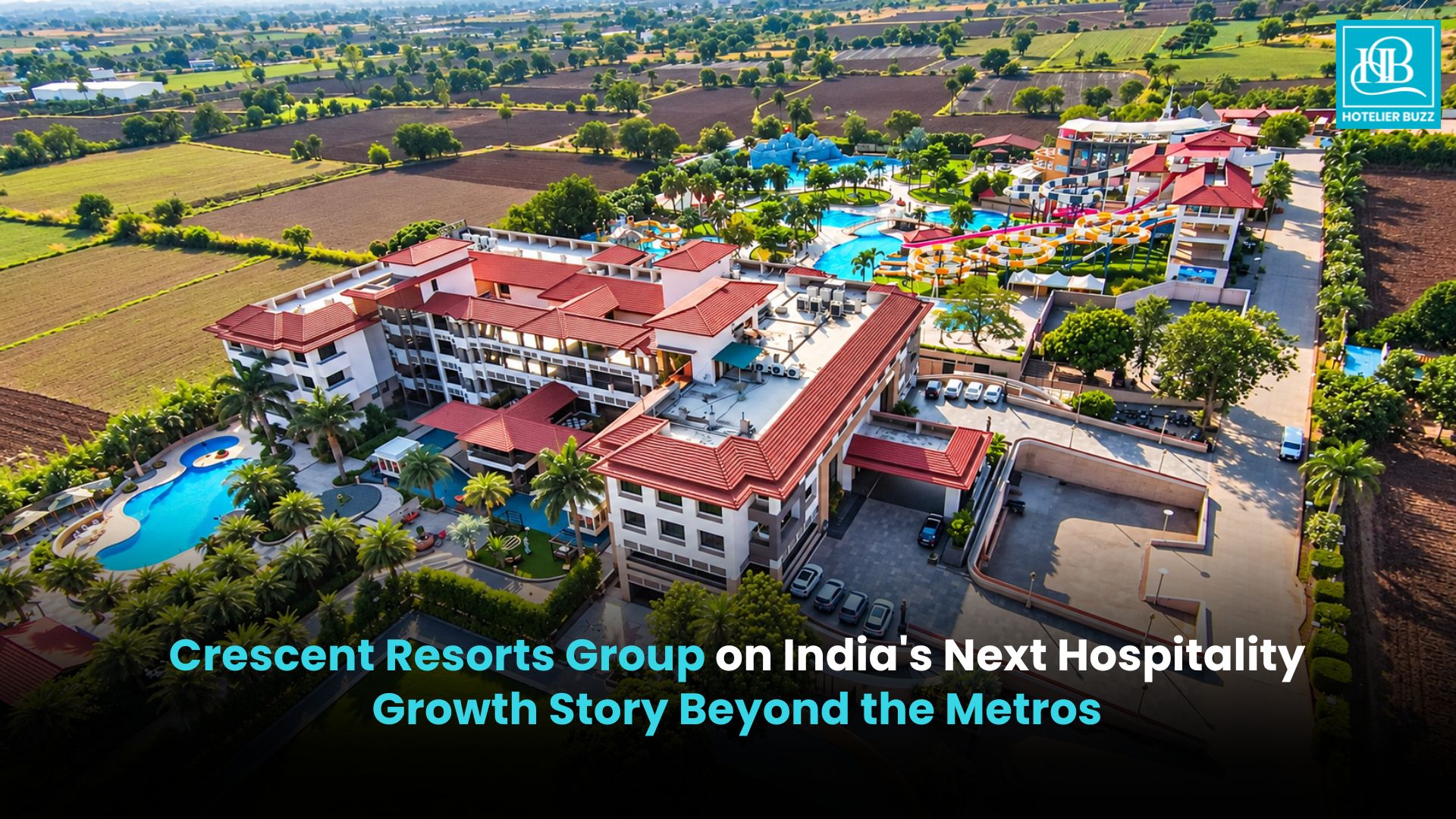
Crescent Resort Sehore traces its origins to Crescent Hotel in 1995, followed by Crescent Resort & Club in 2005. Located along the Indore–Bhopal highway corridor, the resort has 100 keys across six acres, a Crescent Water Park next door and event facilities, including a 30,000 sq ft lawn.
Crescent Spa & Resort Indore, established in 2015, has approximately 106 rooms and cottages, event venues extending up to 60,000 sq ft, and a Crescent Water Park adjacent to this luxury property.
Although both properties operate in Madhya Pradesh, their geographical contexts differ. Sehore sits on a highway corridor between two cities, while Indore serves an urban market. Their potential customer segments, booking patterns and operating requirements must consequently be evaluated differently.
Crescent’s experience across these settings reinforces an important principle for hospitality investors: the development model must reflect the market it intends to serve. Property specifications alone cannot establish viability; that requires detailed demand analysis and property-level financial assessment.
Five Questions Every Hospitality Investor Should Ask
Before developing a hotel, converting an existing asset or entering an operating partnership,
investors should answer five questions:
- Who will stay? Identify the overnight demand generated by leisure, corporate travel, weddings, MICE, pilgrimage and transit.
- What is the competitive supply? Assess existing and proposed properties by quality, price and location.
- How long will stabilisation take? Provide for the ramp-up period rather than assuming immediate occupancy.
- How seasonal is the market? Evaluate weekday versus weekend demand, peak versus lean periods and local events.
- Who will operate the asset? Examine the operator’s capabilities in revenue management, distribution, sales, cost control and reporting.
These questions are particularly relevant for landowners and developers entering hospitality for the first time. A promising location needs a commercially sound development plan and the capability to execute it.
The Role of Professional Management
A hospitality asset requires more than construction and branding. Its performance depends on how effectively rooms are priced, demand is generated, distribution is managed, costs are controlled and service standards are maintained.
Professional management can help owners establish these disciplines, but the right partnership must be evaluated carefully. Brand affiliation alone does not guarantee performance; the operator’s experience, commercial capabilities, contractual terms and understanding of the local market matter.
For Crescent Resorts Group, the wider opportunity lies in bringing a structured hospitality approach to assets and destinations where owners see potential but need clarity on development, positioning and operations.
Building India’s Next Hospitality Growth Story
The next phase of hospitality expansion will require investors to look beyond metropolitan boundaries without overlooking commercial fundamentals.
Crescent Resorts Group’s journey across Sehore, Indore and Goa provides a starting point for understanding how different markets call for different hospitality strategies. For prospective hotel owners and developers, the objective should be to match the right asset and operating model with demonstrable demand.
The opportunity is not simply to build hotels beyond the metros. It is to develop hospitality assets that can sustain demand, manage costs and create long-term value for their owners.
