
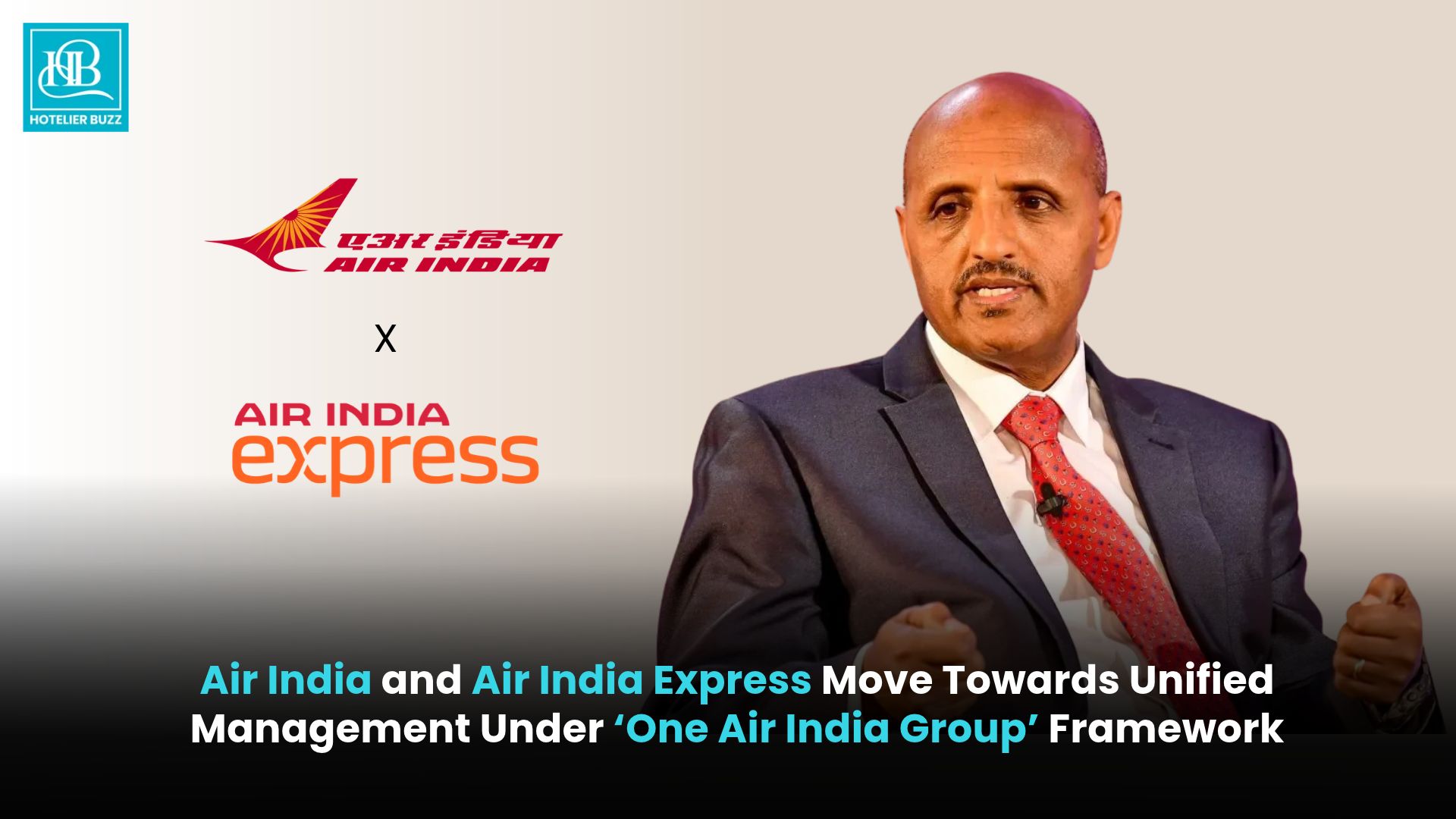
The proposed restructuring will bring key management and support functions under a common group-level structure while allowing both airlines to retain their separate brands, operating models and Air Operator Certificates.
Air India and Air India Express are moving towards a unified management structure under the proposed ‘One Air India Group’ framework, as the Tata Group-owned airline business steps up efforts to reduce costs, improve operational efficiency and strengthen its financial performance.
The restructuring, outlined by Air India CEO and Managing Director Tewolde Gebremariam during an employee town hall on November 25, will bring several management, support and enabling functions of the two airlines under a common group-level framework. However, both carriers will retain their separate brand identities and Air Operator Certificates (AOCs), continuing to operate as distinct full-service and low-cost airlines.
Under the proposed arrangement, functions such as finance, human resources, information technology and Centres of Excellence (CoEs) will increasingly be managed at the group level. The move is intended to reduce duplication, improve resource utilisation and enable greater coordination across the two businesses. Operational, regulatory and customer-facing responsibilities will continue to remain independent under their respective AOCs.
Management Structure and Leadership Changes
As part of the restructuring, the Air India Management Committee will be reconstituted as the Air India Management Team, reflecting the broader group-level approach. Deepak Rajawat, who is scheduled to take over as CEO of Air India Express on December 1, will join the management team, ensuring representation of the low-cost carrier in key group-level decisions.
The group will also introduce two new senior leadership positions: Group Strategy Officer and Chief of Training Academy. The Group Strategy Officer will oversee the group’s strategic direction, including business and network development, alliances and diversification opportunities.
The Chief of Training Academy will bring training and capability development activities across the group under a unified leadership structure, covering its flying academy, flight training organisations and technical training facilities.
Cost Reduction at the Centre of Restructuring
The integration is closely linked to Air India’s wider cost-transformation programme. According to reports citing discussions at the employee town hall, the group has set a savings target of approximately ₹6,000 crore. Of this, opportunities worth around ₹3,500 crore have been identified, while approximately ₹1,500 crore in savings has already been achieved.
The airline is also targeting a 20% reduction in non-fuel costs and a 5% reduction in fuel costs. An 11-member senior management team is working on the cost-reduction programme, while an internal employee initiative has received around 1,500 suggestions for improving efficiency and controlling expenditure.
The restructuring comes amid financial pressure on the airline group. Air India’s consolidated net loss stood at ₹22,238 crore in FY2025-26, while revenue declined to ₹71,870 crore, according to reported financial figures. Improving cost structures, operational reliability and aircraft utilisation will therefore be important priorities under the new leadership.
Separate Airline Models to Continue
Despite the move towards greater integration, the two airlines will continue to serve different market segments. Air India will retain its full-service positioning, focusing on domestic and international markets, while Air India Express will continue operating as the group’s low-cost carrier.
The distinction is also reflected in the decision to retain separate AOCs, ensuring that flight operations, regulatory compliance and customer-facing responsibilities remain independently managed.
For the travel trade, the proposed framework could bring greater coordination across the group’s commercial and support functions while preserving the distinct product offerings of the two airlines.
Focus Shifts to Operational and Financial Synergies
The ‘One Air India Group’ approach marks another phase in the group’s ongoing transformation following the consolidation of its aviation businesses. The focus is now shifting towards extracting operational and financial synergies from the combined scale of the two carriers, while maintaining their individual market identities.
Further details regarding the revised organisational structure, leadership responsibilities and reporting arrangements are expected as the restructuring progresses.
