
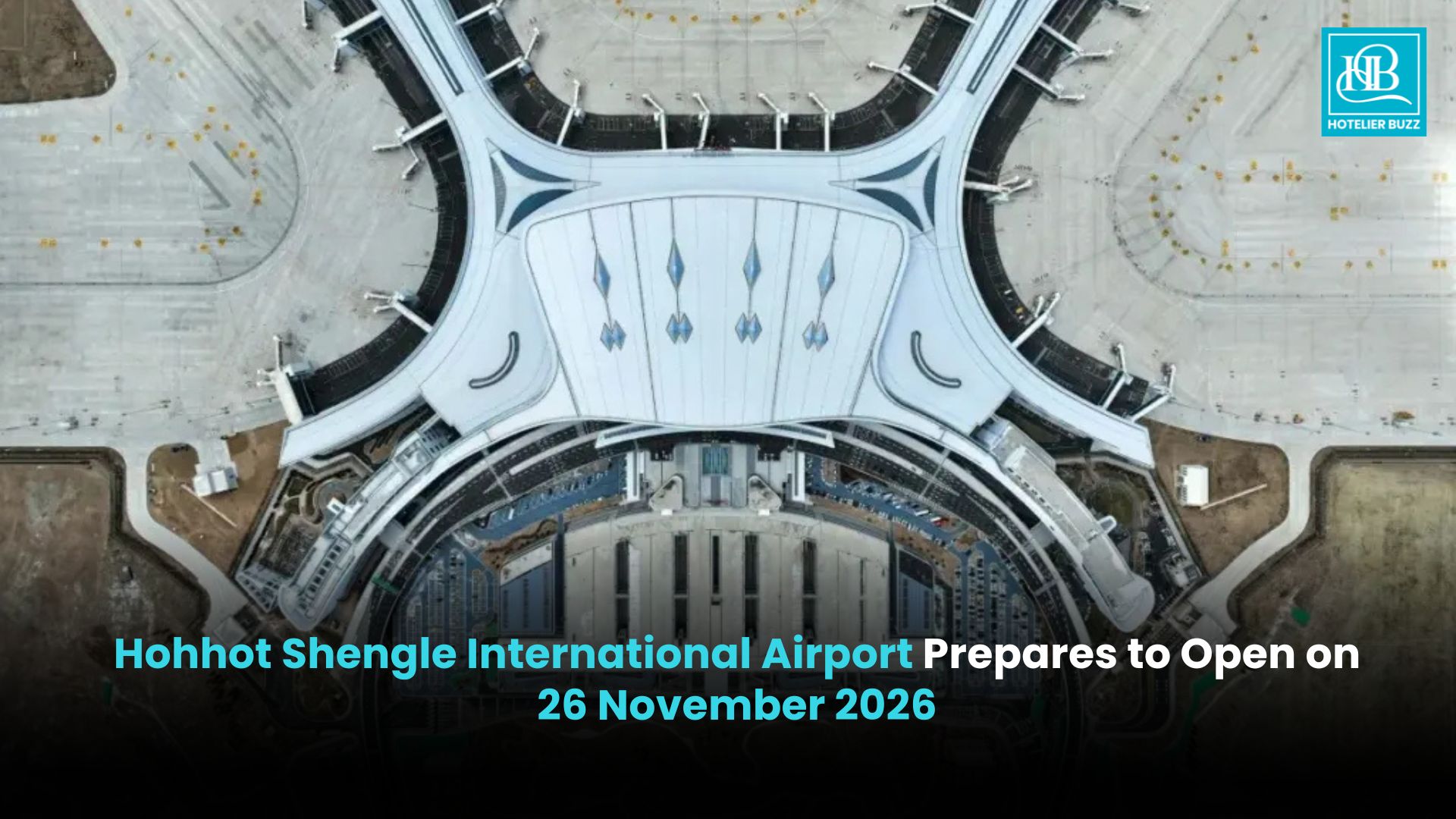
Hohhot Shengle International Airport is scheduled to begin operations on November 26, 2026, replacing Baita International Airport after 68 years of service. The new facility will become the first 4F-class international airport in China’s Inner Mongolia Autonomous Region, significantly expanding the region’s passenger and cargo handling capacity.
The airport is expected to strengthen Hohhot’s position as a regional aviation hub, improve international connectivity and serve as an alternate airport for the Beijing–Tianjin–Hebei airport cluster. The development also forms part of broader efforts to improve transport connections between Inner Mongolia, other Chinese economic centres and international markets.
Hohhot Shengle International Airport to Replace Baita Airport
The opening marks a major transition in Hohhot’s aviation infrastructure, with commercial operations moving from Baita International Airport, which began operating in 1958.
Baita’s original development plan anticipated annual passenger traffic of three million by 2015. However, subsequent economic development, tourism activity and increasing demand for air travel placed pressure on its existing infrastructure.
Shengle International Airport has been developed to accommodate higher traffic volumes while providing additional capacity for international passenger services and cargo operations.
The new airport will also support regional aviation connectivity and transport activities associated with China’s Belt and Road Initiative.
New Airport Designed to Handle 28 Million Passengers Annually
Hohhot Shengle International Airport features a 320,000-square-metre passenger terminal, two parallel runways separated by 2,000 metres and an apron accommodating 130 aircraft stands.
The airport has been designed with an annual handling capacity of 28 million passengers, 320,000 tonnes of cargo and mail, and 244,000 aircraft movements.
The terminal includes designated international departure areas, facilities for flights to Hong Kong, Macao and Taiwan, and international check-in counters.
Chinese and English signage has been incorporated to assist passenger movement through the facility.
In March 2026, the airport’s port-of-entry facilities passed the autonomous region’s acceptance inspection. Customs, immigration and other inspection infrastructure has been installed to support international operations.
International Routes to Transfer to Shengle Airport
Hohhot’s existing international passenger services are expected to transfer to Shengle International Airport following its opening.
Before the relocation, the city operated six regular international passenger routes connecting Hohhot with Ulaanbaatar, Seoul, Daegu, Busan, Vladivostok and Bangkok via Chongqing.
The Ulaanbaatar service represents an important direct aviation connection between Inner Mongolia and Mongolia.
Between January and July 2026, Baita International Airport handled 997 inbound and outbound cross-border flights, representing a year-on-year increase of 69.9%.
International passenger traffic reached 69,200 during the same period, an increase of 89.3% compared with the corresponding period in 2025.
These figures indicate growth in cross-border aviation activity ahead of the airport transition.
Airport Plans Additional Services to Russia and Mongolia
Following the relocation, plans include gradually expanding international air services to Russia and Mongolia.
The airport also intends to strengthen domestic connections with the Yangtze River Delta, the Guangdong–Hong Kong–Macao region and the Chengdu–Chongqing economic area.
Additional regional feeder connections are planned to improve access between Hohhot and surrounding destinations.
The proposed network expansion is intended to improve the movement of business travellers, tourists and international passengers through Inner Mongolia.
The new facility’s additional capacity will provide infrastructure for future route development, although individual airline schedules and launch dates for additional services have not been specified.
Shengle Airport to Support Regional Trade and Tourism
The airport’s development forms part of Inner Mongolia’s wider transport connectivity strategy.
Hohhot is also developing international transport connections through 22 international transport routes and freight train services linking China with more than 70 stations across over 10 countries in Europe and Asia.
The new airport is expected to complement these connections by supporting passenger movement, air cargo operations and cross-border commercial activity.
Its integration with border ports, international trade platforms, China–Europe freight services and cross-border e-commerce networks is intended to strengthen regional transport infrastructure.
The scheduled opening on November 26 represents a significant capacity expansion for Inner Mongolia’s aviation sector, with implications for tourism accessibility, international business travel and regional economic connectivity.
