

Organised co-living penetration remains below 5%, while the market is projected to reach USD 1.96 billion by 2031
India, August 2026: India’s co-living sector is facing a significant demand-supply gap, with approximately 6.6 million beds of demand in 2025 compared with only around 300,000 organised beds, according to a new study by NOESIS, India’s hotel and branded residences advisory firm. The figures indicate that organised operators currently serve less than 5% of the addressable market. Independent industry research also puts organised supply at around 300,000 beds against 6.6 million beds of demand, highlighting the scale of the opportunity. (The Columns)
The study, The Evolution of Co-Living: Market Dynamics and Investment Potential, projects India’s organised co-living market to grow from USD 0.53 billion in 2025 to USD 1.96 billion by 2031, representing a CAGR of 24.34%. Organised inventory is expected to increase to nearly one million beds by 2030, although penetration would still remain only marginally above 10% against an estimated demand of 9.1 million beds.
Demand Driven by Employment, Education and Industry
NOESIS identifies three major structural drivers behind India’s co-living demand: offices and Global Capability Centres, higher education and industrial development.
India recorded 83.3 million sq. ft. of gross office leasing in 2025, while GCCs accounted for 31.4 million sq. ft. of leasing. The continued expansion of employment hubs is creating sustained demand for flexible and professionally managed accommodation.
Education is another significant demand driver. Higher education enrolment stands at nearly 4.5 crore students, while campus accommodation meets only around 33% of an estimated 12 million-bed student living requirement.
Industrial development is creating another largely untapped workforce housing opportunity, with the India Industrial Land Bank mapping more than 4,500 industrial parks across approximately 7.70 lakh hectares.
Significant Gaps Across Major Cities
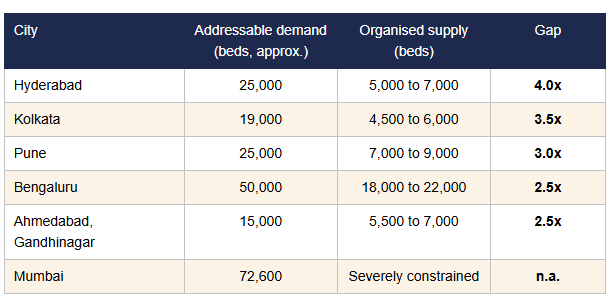
The demand-supply imbalance is particularly visible across India’s major employment and education hubs.
Hyderabad has an estimated addressable demand of around 25,000 beds against organised supply of approximately 5,000 to 7,000 beds. Pune has around 25,000 beds of demand compared with 7,000 to 9,000 organised beds, while Bengaluru has an estimated demand of 50,000 beds against approximately 18,000 to 22,000 organised beds.
Delhi NCR accounts for approximately 17% of national demand, supported by significant higher education and corporate relocation activity.
Co-Living as an Operating Business
NOESIS positions co-living as an operating business rather than simply a residential rental model.
Professionally managed co-living assets can generate a 30–55% revenue premium over traditional single-lease residential formats. However, this comes with higher operating costs, with expense ratios estimated at 60–75%, compared with 35–45% for conventional residential assets.
Healthy operators target stabilised occupancy of 92–95%, while asset-light models can deliver NOI margins of 10–20% and asset-heavy ownership models 30–40%.
Nandivardhan Jain, Founder and CEO, NOESIS, said,
“India keeps calling this a real estate opportunity. It is not. Co-living is an operating business that happens to occupy a building, and it behaves like one. Real estate rewards patience. Operating businesses punish inconsistency. The demand gap will get filled either way. Whether owners make money from it depends on which of those two businesses they think they are in.”
Eight Distinct Demand Segments
The study cautions against treating co-living as a single product. NOESIS identifies eight key demand segments: students, first-jobbers, young professionals, corporate trainees, consultants, interns, healthcare workers and migrant workforce.
The report also highlights a shift in consumer preferences, with private rooms accounting for 45.7% of market preference, indicating movement away from the shared-dorm origins of the category. The mid-scale segment accounts for 60.2% of inventory, highlighting where the largest volume opportunity currently lies.
The Operational Challenge
While demand remains strong, NOESIS argues that maintaining profitability requires disciplined operations.
Vijay Bhandari, Chief Operating Officer, NOESIS, said,
“Occupancy is not the hard part. Holding 92 per cent occupancy while keeping the expense ratio below 70 per cent is the hard part, and that is where most operators lose the asset. Consistency in operations is what turns this from a rental arbitrage into a real business.”
The report suggests that India’s co-living opportunity will increasingly depend on professional management, differentiated products, efficient operations and the ability to build trust with residents.
With organised penetration still below 5%, the sector has substantial room for expansion as employment, education and industrial migration continue to drive demand for professionally managed rental accommodation.
